The bed gets all the attention when a bedroom is planned, yet the bedside table is the piece you reach for last thing at night and first thing in the morning. Get its height or size wrong and you notice every day, from a lamp you cannot switch off without sitting up to cables trailing across the floor. This guide explains how to choose bedside tables that actually suit your bed and your room.
Why are bedrooms getting attention this month?
Because mid-November brings two reasons to look again at the bedroom. The wedding season reopens with Devutthana Ekadashi (20 November this year), so many Delhi families are readying a room for a newly married couple. And with smog keeping people indoors, the bedroom is doubling as a reading, resting and work-from-bed space.
The air has been a constant backdrop: Stage III of GRAP has stayed in force across Delhi-NCR since 6 November, with the city’s AQI still in the ‘poor’ band this week, according to Business Standard. Design-wise, 2026 bedrooms favour warm, tactile materials and softer, rounded forms over stark, glossy sets.
How tall should a bedside table be?
A bedside table should sit at roughly the same height as the top of your mattress, or within about 5 cm above or below it. That lets you reach a lamp, phone or glass of water without stretching or twisting. Most bedside tables fall between about 55 and 70 cm, but always measure your own bed first.
Measure from the floor to the top of the mattress, including any topper, not to the bed frame. Upholstered beds with a deep mattress can sit noticeably higher than a low platform bed, so a table that looked right in a catalogue may be wrong next to yours. Ideal Home’s guide to bedside table height gives the same advice from several designers: level with the mattress, or a touch higher.
If you are still choosing the bed itself, settle that first. Indesign’s guide to upholstered versus wooden beds covers how the two differ in height, comfort and upkeep.
How wide and deep should a bedside table be?
Width should match the bed’s scale: a slim table looks lost beside a king, and a bulky one crowds a queen in a compact room. Roughly, allow 40 to 45 cm for compact rooms, 45 to 55 cm for queen beds and 55 to 65 cm for king beds, with a depth of 35 to 45 cm.
These are general starting points rather than fixed rules; the space you have on each side matters most. Leave a small gap of 5 to 10 cm between the table and the bed frame, and enough floor to step in and out of bed comfortably.
| Bed and room | Bedside table width (approx.) | What works well |
|---|---|---|
| Single or compact guest room | 35 to 45 cm | Slim table with one drawer, or a wall-mounted ledge |
| Queen bed (about 5 x 6.5 ft) | 45 to 55 cm | A pair of drawer tables or a drawer table and an open stand |
| King bed (about 6 x 6.5 ft) | 55 to 65 cm | Wider chests or tables with two drawers, so the pieces match the bed’s scale |
| Wide headboard or panelled wall | Planned with the headboard | Tables designed as part of the headboard or bed surround |
Drawers, open shelves or a floating table: which is best?
It depends on what lives beside your bed. Drawers hide chargers, medicines and reading glasses, and keep dust off them. Open shelves suit books and look lighter. Wall-mounted tables free up floor space in small rooms. Pedestal and sculptural tables look beautiful but offer the least storage, so they suit tidy sleepers.
| Type | Storage | Look | Best for | Watch out for |
|---|---|---|---|---|
| Table with drawers | High; contents stay hidden | Classic, solid | Main bedrooms, anyone with lots of bedside clutter | Can feel heavy in small rooms |
| Open shelf or nightstand on legs | Moderate; everything is on show | Light and airy | Readers, compact rooms | Collects dust faster in smog season |
| Wall-mounted (floating) | Low to moderate | Clean and architectural | Small rooms, easy floor cleaning | Needs a sound wall and planned wiring |
| Sculptural pedestal | Low | Statement, almost art | Minimal bedrooms, one side of a mismatched pair | Little room for lamp, books and phone together |
Which materials suit a Delhi bedroom?
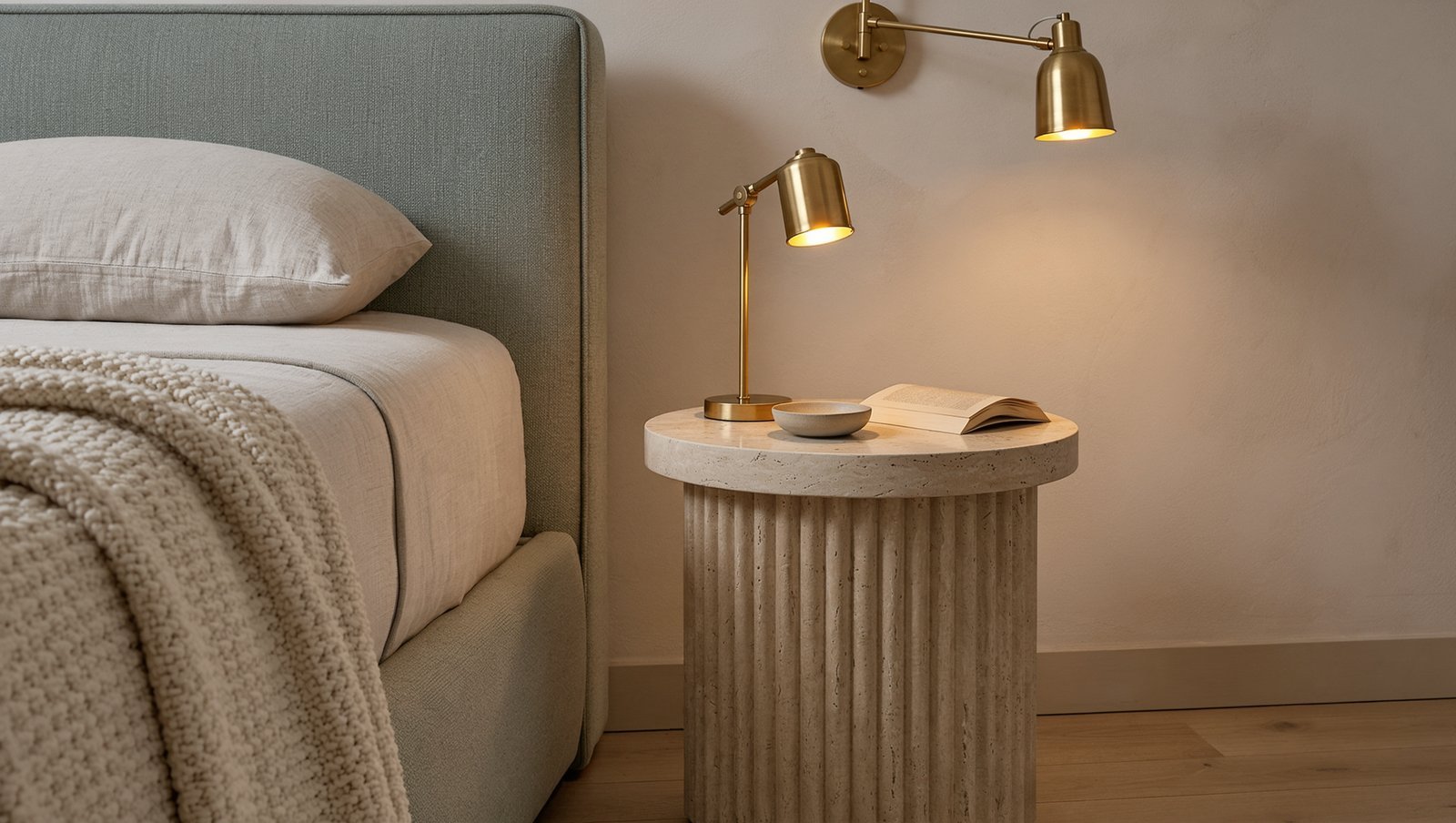
Choose surfaces that are easy to wipe and that age gracefully. Wood veneers and solid wood bring warmth and suit most beds. Stone tops such as marble or travertine look luxurious, though they need coasters to avoid marks. Upholstered or leather-wrapped tables blend into an upholstered bed. Lacquer and glass look sleek but show fingerprints and fine dust quickly.
In the smoggy months, fine dust settles on every horizontal surface, so closed drawers and sealed finishes are easier to keep clean. Use coasters on wood, and dust with a soft, slightly damp cloth rather than a dry one, which can scratch. Indesign’s winter furniture care guide for Delhi’s smog season has more on caring for wood, fabric and leather through the winter.
Should bedside tables match the bed?
They should relate to it, but they need not match exactly. A matching pair suits a symmetrical, formal bedroom. A related pair in different shapes, or two quite different tables, feels more collected and lets each person have the storage they need. Keep the heights similar so the bed still looks balanced.
Some beds solve the question in their design. Indesign’s Noctura Collection, for example, has an upholstered panel that continues in a curved form towards the side table, so bed and bedside read as one composition. Rounded and sculptural pieces are part of a wider shift: The Times of India recently reported that affluent homeowners are moving away from catalogue-matched sets towards distinctive, sculptural furniture.
What about bedside lamps, lights and charging?
Plan lighting and power at the same time as the table. A table lamp’s shade should sit at about shoulder height when you are sitting up in bed, so the light falls on your book rather than in your eyes. Wall-mounted lights free up the tabletop entirely. Place sockets just above table height to avoid trailing cables.
In a new home, fix wall lights and switch points before the walls are finished. A drawer organiser keeps chargers in one place, and a cable grommet at the back of the table keeps leads tidy.
Frequently asked questions
What is the standard height of a bedside table?
Most bedside tables are roughly 55 to 70 cm tall, but there is no single standard. The right height is the height of the top of your mattress, measured from the floor, give or take about 5 cm. Measure your own bed, including any topper, before you shop.
Should a bedside table be higher or lower than the bed?
Ideally level with the mattress top. If it cannot be exact, slightly higher is usually easier to live with than lower, because reaching down over the edge of the bed is more awkward than reaching across.
How much space do you need for a bedside table?
Allow the table’s width plus a little breathing room, ideally 5 to 10 cm from the bed frame and enough clear floor to get in and out of bed comfortably. In tight rooms, a narrow or wall-mounted table usually works better than squeezing in a standard one.
Do both bedside tables have to match?
No. Matching pairs suit symmetrical, formal bedrooms, while a mismatched pair gives each side its own storage and feels more personal. Keep the two at a similar height and in a related material or tone so the bed still looks balanced.
Can bedside tables be made to suit a custom bed?
Yes. When a bed is made to order, the bedside tables can be sized and finished around it, from height and width to drawer layout and upholstery. At Indesign, beds and bedside pieces can be planned together at the Kirti Nagar showroom.
If you are planning a bedroom, whether for a new home or a newly married couple, it helps to see beds and bedside pieces together at full size. Visit the Indesign showroom in Kirti Nagar at C-29A, Block F, Mansarover Garden, opposite Kirti Nagar Fire Station, New Delhi 110015 (open daily, 10:30am to 8pm), or call +91 93108 51211. You can also browse Indesign’s bedroom collection online first.